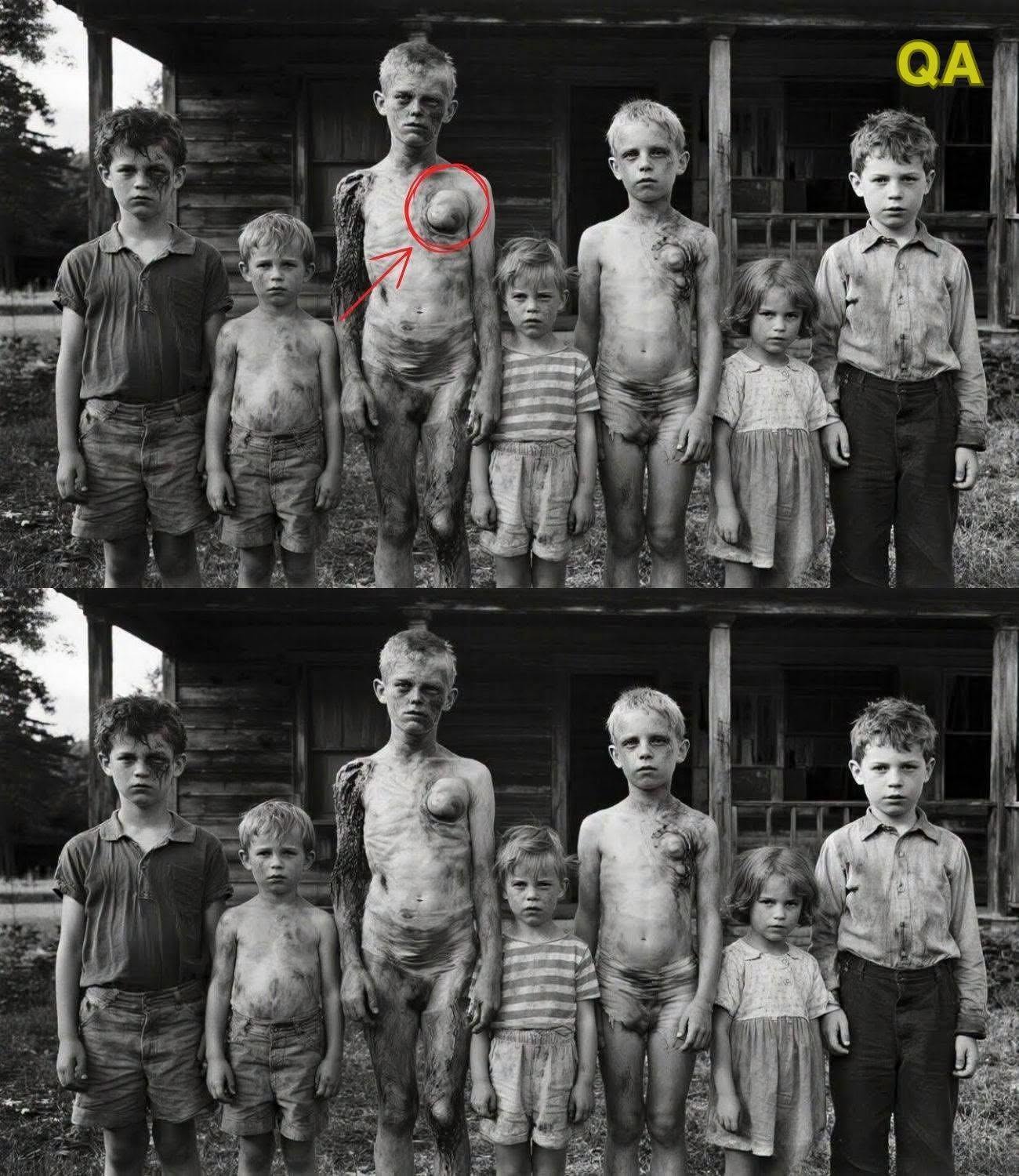
The moment Sheriff Thomas Brennan heard the silence inside the barn, he knew it was not normal.
It was not the silence of frightened children.
It was not the silence of confusion.
It was the silence of something rehearsed—something practiced so many times that it no longer required thought.
Seven children stood in a perfect line.
Not shifting. Not whispering. Not even blinking in the way human beings naturally do when confronted with strangers.
And yet the most disturbing part was not their condition.
It was their coordination.
Every single child faced him with the same posture. The same angle of the head. The same rigid stillness that did not belong in a barn, or a farm, or anywhere children were supposed to exist.
Deputy Morris was right behind him, but even he refused to step forward again.
“They’ve been like that since sunrise,” Morris whispered. “Same positions. Same line. Like they were placed there.”
Brennan swallowed hard.
“Who taught them that?” he asked.
Morris didn’t answer.
Because there was no answer that made sense.
The Harlow Name
At the mention of the Harlow family, something subtle changed in the atmosphere.
Not the children.
Not their faces.
But the space itself, as if the barn remembered something it did not want to repeat.
The Harlow estate had always been strange.
Locals in Milbrook avoided it without ever explaining why. Farmers would cross themselves when passing the property. Children were told not to approach it “after sundown,” though no one ever explained what happened at sundown.
The Harlows themselves were rarely seen in town.
Mr. Harlow was described as a man who spoke little and worked constantly. Mrs. Harlow was described as even quieter. And the children—there were rumors of many children—but no one could ever confirm exact numbers.
They were simply… present in the background of the county’s memory.
Like a stain that never quite washed out.
And now, suddenly, all seven were standing in front of the sheriff like a question that had been waiting decades to be answered.
The First Movement
Sheriff Brennan took one step forward.
Then another.
The wood beneath his boots creaked loudly in the barn’s hollow space.
Still, the children did not react.
He stopped at what he estimated was a safe distance.
“Can you hear me?” he asked again.
Nothing.
Then, without warning, the smallest child—the one standing near the center—tilted her head exactly 17 degrees to the left.
It was not a natural movement.
It was precise.
Mechanical.
As if responding to an instruction only she could hear.
Then she spoke.
Not loudly. Not emotionally.
Just clearly.
“We are not missing,” she said.
The barn went colder.
Even Morris shifted behind him.
Brennan blinked.
“What did you say?”
The girl repeated it, perfectly unchanged.
“We are not missing.”
Then, as if rehearsed, the others echoed her in sequence.
One after another.
Same words.
Same tone.
Same timing.
“We are not missing.”
“We are not missing.”
“We are not missing.”
The Sheriff’s Instinct
Sheriff Brennan had dealt with criminals, drifters, miners, and men who lied easily.
But children did not lie like this.
Children broke. Children cried. Children reacted.
These children did none of that.
Instead, they behaved like a single unit.
A single mind distributed across multiple bodies.
Brennan slowly lowered himself slightly to be eye level with the tallest boy.
“What happened here?” he asked.
The boy blinked once.
Only once.
Then replied:
“The instructions are complete.”
Behind him, Deputy Morris dropped his lantern.
The glass shattered on the barn floor.
The sound should have triggered a reaction.
It did not.
The children did not even look down.
The House Behind the Barn
Brennan made a decision that would later define his entire career.
He turned toward the house.
“Stay here,” he ordered Morris.
“I don’t think that’s wise,” Morris replied.
But Brennan was already walking.
The house loomed in the winter fog like a structure that had forgotten how to belong in time. The wood siding was weather-worn, almost peeling away from itself. The porch leaned slightly, as if tired of holding weight.
The front door was unlocked.
That was the second warning.
Inside, the house was too clean.
Not clean in a maintained way.
Clean in a stripped way.
No dust where dust should naturally exist in an old farmhouse.
No scattered objects.
No signs of daily life.
Just empty rooms arranged like they were waiting to be filled by something that had not arrived yet.
Brennan moved slowly through the hallway.
Then he saw it.
A wall covered in markings.
Not writing.
Not symbols from any known language.
But patterns.
Repeated patterns.
Drawn in charcoal or ash.
Circles within circles.
Lines that intersected in impossible geometry.
And in the center of it all—
Handprints.
Small handprints.
Hundreds of them layered over one another.
As if children had pressed their hands into the wall repeatedly over years… not in play, but in repetition.
As if instructed.
The Record Book
On a table in the main room lay a single leather-bound book.
Open.
Waiting.
Brennan approached it cautiously and turned the page.
Names.
Not all children were listed.
But enough were.
Followed by dates.
Followed by phrases that made no sense.
“Phase One: Observation through stillness.”
“Phase Two: Removal of spontaneous movement.”
“Phase Three: Unified response training.”
Brennan felt his stomach tighten.
This was not a farm record.
This was not education.
This was conditioning.
The final page contained only one sentence:
“When they no longer hesitate, they will no longer be children.”
The Return to the Barn
Brennan ran.
For the first time in years, he ran without care for composure or authority.
Morris was still at the barn door, pale and unmoving.
“They haven’t moved,” Morris said quickly. “Not even a finger.”
Brennan looked inside.
And froze.
Because now the children were facing the barn entrance.
All seven of them.
Perfectly aligned.
Perfectly synchronized.
As if they had been waiting for him to return.
The smallest child spoke again.
But this time, her voice was different.
Slightly louder.
“Instruction received.”
The tallest boy followed.
“Observer acknowledged.”
Then another.
“Assessment complete.”
Brennan stepped back instinctively.
“What are you talking about?”
The children answered in unison.
“We are learning you.”
The Unthinkable Realization
Something in Brennan’s mind shifted.
These were not abandoned children.
They were not lost.
They were not even simply neglected.
They were being trained.
But not for survival.
Not for labor.
Not for anything human society understood.
This was something else.
Something structured.
Something deliberate.
Something that treated childhood not as innocence—but as a system to be rewritten.
And then Brennan noticed something he had missed before.
Their eyes.
Not empty.
Not fearful.
But observational.
Like they were not the subjects of the moment.
He was.
The Town That Would Not Believe
When Brennan finally returned to Milbrook, he reported everything.
Every detail.
Every word.
Every observation.
But by the next morning, the official response was already forming.
“Confusion due to trauma exposure.”
“Children likely malnourished and disoriented.”
“Possible misinterpretation of rural conditions.”
No one came to the farm.
No investigation followed immediately.
Because what Brennan described did not fit any known category of law, medicine, or psychology.
So the town chose the easiest explanation:
He was mistaken.
But Brennan knew what he saw.
And more importantly—
He knew what the children saw.
The Final Return
Three days later, Brennan went back alone.
The barn doors were open again.
But this time—
The children were gone.
No footprints leaving.
No signs of struggle.
Only the line in the dirt remained.
Perfectly straight.
As if someone had measured where they once stood.
And on the barn wall, newly carved into the wood, was a single sentence:
“Observer phase complete.”
Epilogue: The Case That Never Closed
The Harlow estate was eventually sealed off.
Records were lost.
Files disappeared.
Some said the children were relocated.
Some said they never existed in the way Brennan described.
But Sheriff Thomas Brennan never changed his story.
Until the day he died, he maintained the same final statement:
“They were not lost children. They were something learning how to be seen.”
And the most disturbing part?
He always added one final line.
Quietly.
Almost like he was afraid they might hear him again.